
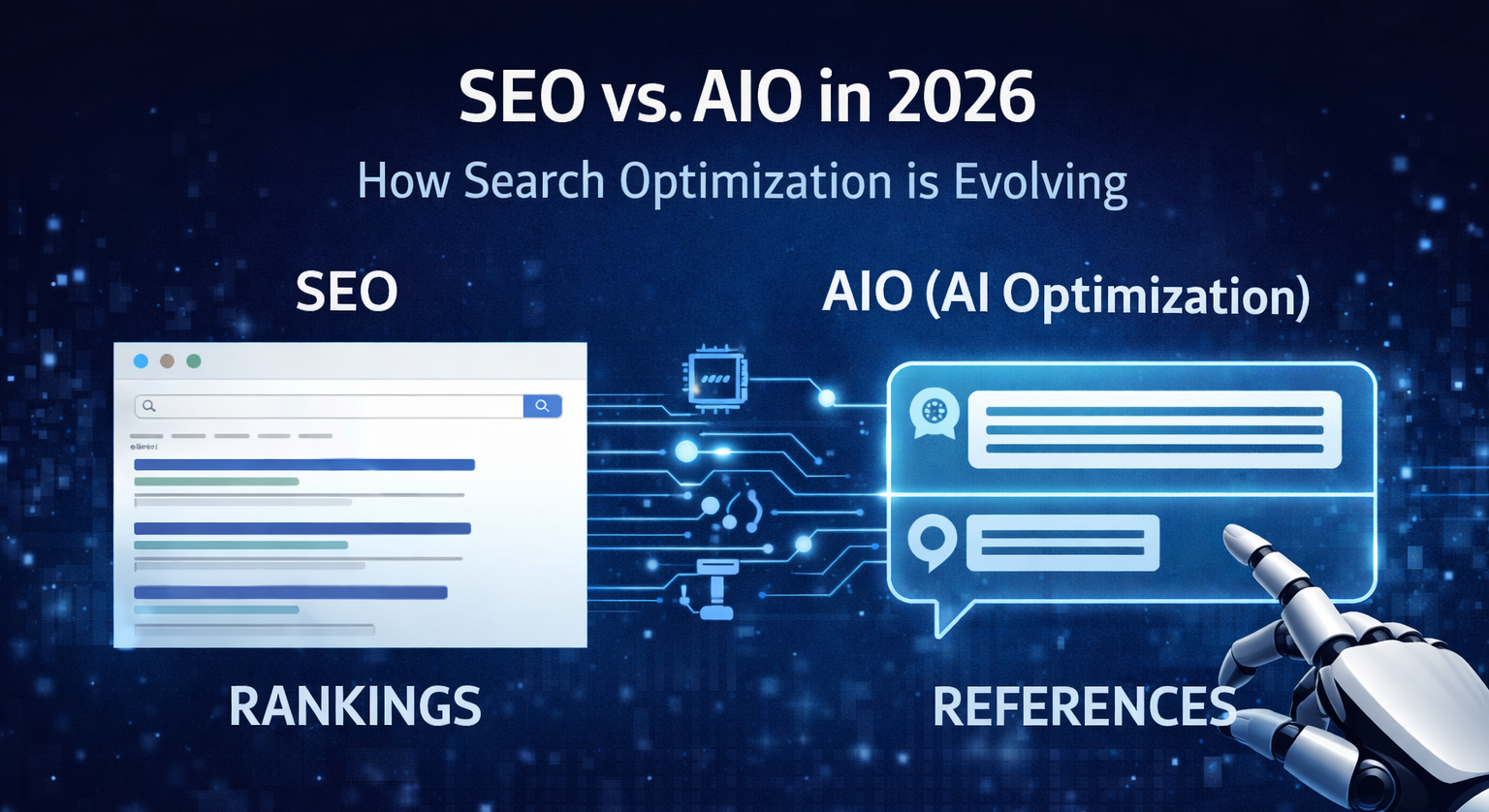

Search optimization is entering a new phase. Traditional search engine optimization (SEO) is no longer the only method for gaining visibility online. The rise of artificial intelligence in search experiences is introducing a parallel discipline: AI Optimization (AIO).
As platforms like Google integrate AI-generated answers into search results and conversational interfaces, businesses must adapt their strategies to remain visible, competitive, and relevant.
At SharedReach Marketing, we see SEO and AIO not as competing approaches, but as complementary systems that together define the future of digital visibility.
What Is SEO?
Search Engine Optimization (SEO) refers to the process of improving a website’s visibility in traditional search engine results pages (SERPs). It focuses on increasing organic traffic through ranking improvements.
Core components of SEO include:
- Keyword research and targeting
- On-page optimization (content, headings, metadata)
- Technical performance (site speed, indexing, mobile usability)
- Backlink acquisition and authority building
SEO remains a foundational element of digital marketing. However, the way users interact with search engines is changing.
What Is AIO (AI Optimization)?
AI Optimization (AIO) refers to the process of optimizing content and digital presence for AI-driven search systems. Instead of focusing solely on ranking in a list of links, AIO focuses on being selected, summarized, and recommended by AI models.
This includes visibility in:
- AI-generated search answers
- Conversational search interfaces
- Voice assistants and chat-based platforms
AIO prioritizes:
- Contextual relevance
- Content clarity and structure
- Authority and trustworthiness
- Direct, concise answers to user queries
The Shift from Rankings to Recommendations
Traditional SEO is built around rankings. The goal is to appear on the first page of search results and drive clicks.
AIO introduces a different dynamic.
AI systems increasingly provide direct answers, reducing the need for users to click through to websites. As a result, visibility is no longer defined only by position, but by inclusion in AI-generated responses.
This shift has several implications:
- Fewer clicks, but higher intent visibility
- Increased importance of structured, answer-focused content
- Greater emphasis on topical authority
Businesses must now optimize not just to rank, but to be referenced.
How SEO and AIO Work Together
SEO and AIO are most effective when integrated into a single strategy.
SEO Drives Discoverability
Search engines still rely on traditional signals to crawl, index, and evaluate content. Strong SEO ensures your content is accessible and authoritative.
AIO Drives Selection
AI systems prioritize content that is clear, structured, and directly answers user intent. AIO ensures your content is usable within AI-generated outputs.
Combined Impact
When properly aligned, SEO and AIO:
- Increase overall visibility across search environments
- Improve authority and credibility
- Capture both click-based and zero-click traffic opportunities
Key Strategies for SEO and AIO in 2026
1. Create Structured, Answer-Focused Content
Content should be designed to answer specific questions clearly and directly. Use headings, bullet points, and concise explanations to improve readability for both users and AI systems.
2. Build Topical Authority
Rather than focusing on isolated keywords, businesses should develop comprehensive content ecosystems around core topics. Depth and consistency signal expertise.
3. Optimize for Search Intent
Understanding user intent is critical. Content should align with informational, navigational, and transactional queries while providing meaningful value.
4. Strengthen Technical Foundations
Fast-loading, mobile-optimized, and properly indexed websites remain essential. Technical SEO continues to support both traditional rankings and AI visibility.
5. Leverage High-Quality Data and Insights
Accurate data improves both SEO performance and AI interpretation. Clear signals, structured data, and consistent formatting enhance content usability.
Common Challenges Businesses Face
Many organizations struggle with the transition from SEO to a combined SEO and AIO approach.
Common issues include:
- Over-reliance on keyword density rather than content quality
- Lack of structure in long-form content
- Failure to adapt to changing search behaviors
- Limited understanding of how AI systems interpret content
Addressing these challenges requires both strategic planning and ongoing optimization.
The Future of Search Optimization
Search is evolving from a discovery engine into a decision engine. AI is accelerating this shift by delivering immediate, context-aware answers.
As this transformation continues, businesses that invest in both SEO and AIO will be better positioned to:
- Maintain visibility across platforms
- Adapt to changing user behavior
- Compete in increasingly automated environments
Organizations that rely solely on traditional SEO risk losing relevance as AI-driven search becomes more dominant.
Conclusion
SEO remains a critical foundation for digital visibility, but it is no longer sufficient on its own. AI Optimization introduces a new layer of strategy focused on how content is interpreted and delivered by intelligent systems.
The most effective approach in 2026 is not to choose between SEO and AIO, but to integrate both into a unified framework.
At SharedReach Marketing, we help businesses evolve their search strategies to align with this new reality by combining technical expertise, content strategy, and AI-driven insights to deliver measurable results.