
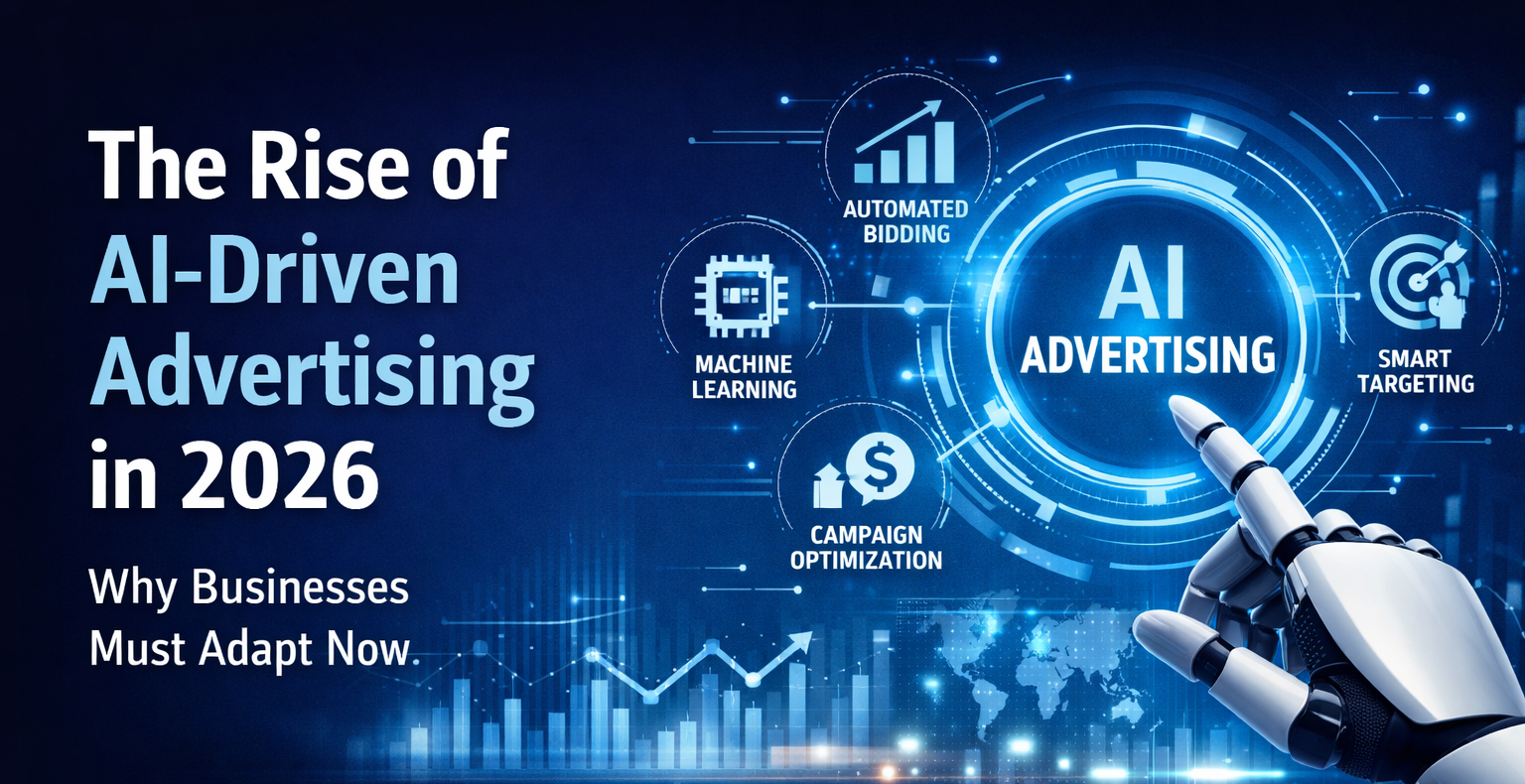

Artificial intelligence is fundamentally reshaping the digital advertising landscape. In 2026, AI-powered advertising is no longer an emerging capability it is becoming the dominant model across major platforms.
Recent industry data indicates that AI-driven ad spend is projected to grow by more than 60% this year, signaling a decisive shift away from traditional, manually managed campaigns. For businesses, this evolution presents both significant opportunities and new strategic challenges.
At SharedReach Marketing, we view this shift as a turning point in how companies approach growth, efficiency, and competitive positioning.
From Manual Campaigns to Algorithmic Execution
Historically, digital advertising required hands-on management. Marketers were responsible for defining audiences, adjusting bids, testing creatives, and optimizing performance over time.
Today, platforms such as Google and Meta are increasingly relying on machine learning systems to handle these functions automatically.
These systems are designed to:
- Analyze large volumes of user data in real time
- Identify high-probability conversion opportunities
- Adjust budget allocation dynamically
- Continuously test and refine ad variations
This transition reduces the need for manual intervention while significantly increasing the speed and scale of optimization.
Key Advantages of AI-Powered Advertising
The rapid adoption of AI in advertising is driven by measurable performance improvements.
Improved Targeting Precision
AI models can process behavioral, demographic, and contextual data simultaneously, enabling more accurate audience targeting than traditional segmentation methods.
Real-Time Optimization
Campaigns are no longer adjusted periodically. Instead, AI systems continuously optimize performance based on live data, reducing inefficiencies and improving return on investment.
Accelerated Testing and Iteration
AI enables simultaneous testing of multiple creative variations, shortening feedback loops and allowing businesses to identify effective messaging more quickly.
Strategic Implications for Businesses
While AI enhances execution, it does not replace the need for strategic direction. In fact, as automation increases, the role of human decision-making becomes more critical in several key areas.
Creative Differentiation
As more advertisers rely on the same underlying algorithms, creative quality becomes a primary differentiator. Businesses must invest in strong messaging, branding, and visual assets to stand out.
Data Interpretation
AI systems generate insights, but businesses must interpret those insights within the context of broader objectives. Understanding customer behavior, lifetime value, and conversion pathways remains essential.
Platform Dependency
As advertising platforms take on more control, businesses become more dependent on their algorithms. This creates both efficiency and risk, particularly in terms of transparency and control over performance drivers.
Common Misconceptions About AI Advertising
Despite its advantages, AI-driven advertising is often misunderstood.
One common misconception is that automation eliminates the need for expertise. In reality, poorly structured campaigns, weak creative assets, and unclear objectives can limit the effectiveness of even the most advanced AI systems.
Another misconception is that AI guarantees results. While it improves efficiency, outcomes still depend on the quality of inputs, including data, targeting signals, and creative direction.
How Businesses Should Adapt
To remain competitive in this evolving environment, businesses should consider the following approaches:
Shift Toward System-Based Marketing
Rather than focusing on individual campaigns, organizations should build integrated marketing systems that leverage AI for continuous optimization.
Prioritize Creative and Messaging
As automation standardizes execution, differentiation increasingly depends on brand voice, value proposition, and content quality.
Strengthen Data Infrastructure
Reliable data is essential for AI performance. Businesses should ensure accurate tracking, attribution, and measurement across channels.
Maintain Strategic Oversight
AI should be viewed as a tool for execution, not a replacement for strategic thinking. Human oversight remains necessary to guide direction and ensure alignment with business goals.
Conclusion
AI-driven advertising represents a structural shift in digital marketing. It offers significant gains in efficiency, scalability, and performance, but also requires a new approach to strategy and execution.
Businesses that successfully integrate AI into their marketing operations while maintaining strong creative and strategic foundations will be better positioned to compete in an increasingly automated landscape.
At SharedReach Marketing, we help organizations navigate this transition by combining advanced technology with a clear, results-driven strategy.